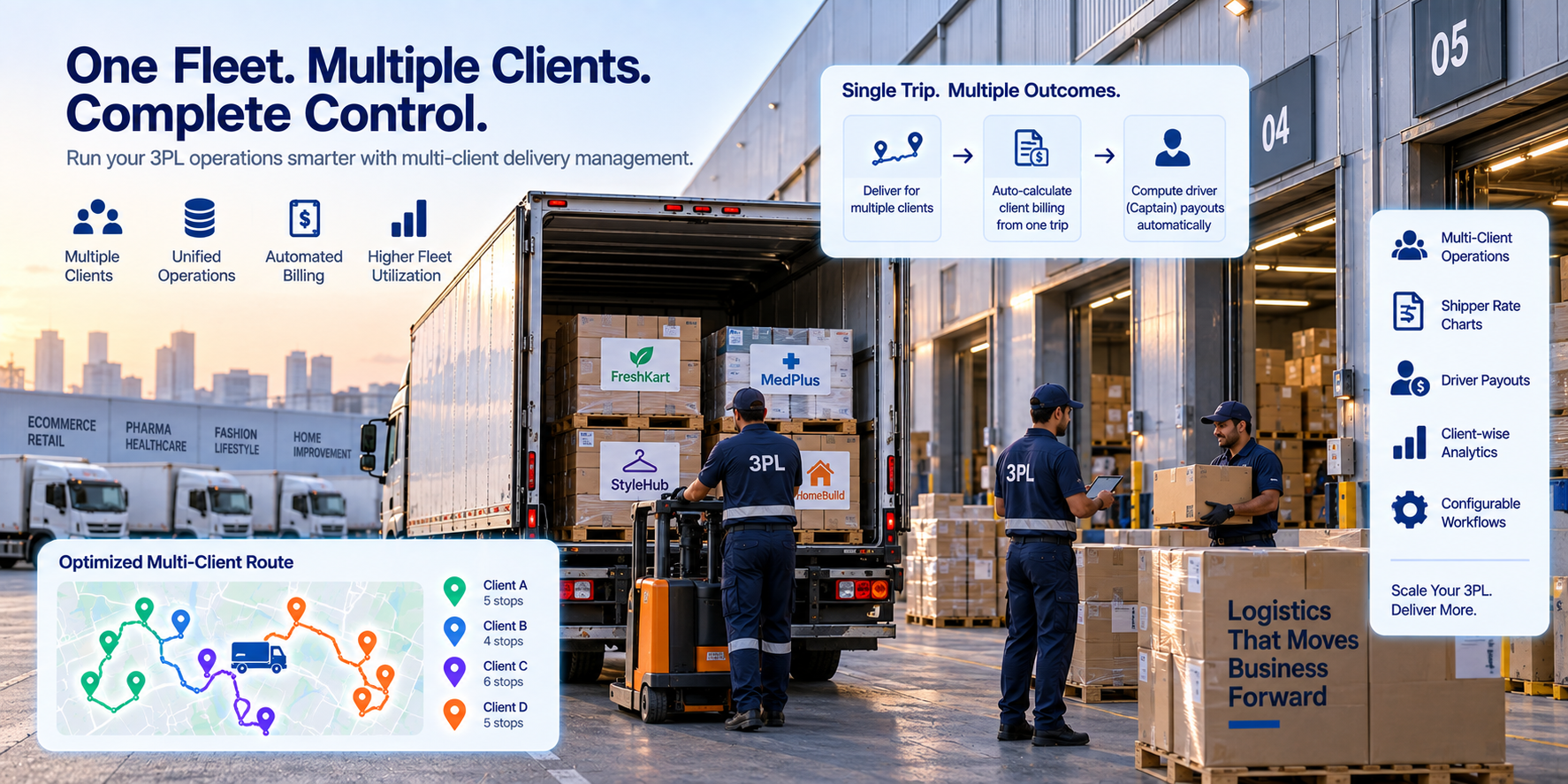
A contract logistics operator wins by sharing capacity across customers more efficiently than each customer could run alone. That advantage disappears when orders sit in separate portals, planners cannot combine compatible work, drivers carry several apps and finance rebuilds invoices from spreadsheets. Multi-client operations require one execution model with strict client attribution.
The central design principle is simple: the route belongs to the operator; every order remains owned by its shipper. The platform may combine compatible stops, but it must preserve the shipper’s service rules, branded communication, permitted users, commercial rate and final proof at order level.
What should 3PL delivery management software separate by client?
Orders
- Client-specific
- References, fields, SLA and service type
- Shared where safe
- Normalized planning attributes
Brand
- Client-specific
- Tracking domain, messages and support contact
- Shared where safe
- Delivery event engine
Access
- Client-specific
- User roles and client-visible records
- Shared where safe
- 3PL control tower for authorized operations
Commercials
- Client-specific
- Rate card, surcharges and invoice rules
- Shared where safe
- Verified trip events and cost ledger
Execution
- Client-specific
- Proof requirements and exceptions
- Shared where safe
- Vehicles, captains and compatible routes
| Area | Client-specific | Shared where safe |
|---|---|---|
| Orders | References, fields, SLA and service type | Normalized planning attributes |
| Brand | Tracking domain, messages and support contact | Delivery event engine |
| Access | User roles and client-visible records | 3PL control tower for authorized operations |
| Commercials | Rate card, surcharges and invoice rules | Verified trip events and cost ledger |
| Execution | Proof requirements and exceptions | Vehicles, captains and compatible routes |
How to combine orders from multiple shippers on one route
Normalize incoming orders into a common operational schema, then retain the source fields for audit and write-back. Eligibility comes first: temperature, product restrictions, branding, vehicle requirements, pickup precedence and contractual exclusions may prevent consolidation. Once incompatible work is removed, optimize the remaining pool across hubs, windows, capacity and route cost.
- Resolve the effective planning profile for each order before optimization.
- Keep pickup-to-delivery precedence when a route collects from multiple client sites.
- Prevent data or proof from one shipper appearing in another shipper’s portal.
- Show drivers a unified task list while retaining order-specific completion steps.
- Write delivery status back to every source system using the client’s identifiers.
Use exceptions to test the operating model
Normal deliveries make almost any setup look integrated. Exceptions reveal whether it is. When a driver is delayed, the system should identify which client SLAs are at risk, apply the correct notification brand, calculate whether a reassignment remains commercially sensible and retain the event for billing. If dispatch must open three portals to answer that question, the control tower is incomplete.
How shipper rate charts should work
A rate chart converts verified execution into a client charge. It may price by zone, distance band, weight, service type, waiting time, attempt, return or special handling. Version the chart with effective dates so an old delivery is never recalculated using a new contract. Surcharges should require the event evidence defined in the agreement.
How captain payouts should use the same trip data
Driver or partner pay may use per-drop, distance, route, hourly or hybrid rules. Compute it from the same verified route events used for billing: accepted work, actual distance, completion, waiting, failed attempts and approved adjustments. A separate payout spreadsheet creates disputes because finance and operations are no longer looking at the same trip.
Reconcile contribution, not just revenue
For every route, compare shipper charges with captain payout, vehicle cost, tolls, waiting and exception cost. A high-revenue client can still destroy margin through low density or restrictive windows.
SLA performance
- Question answered
- Did each client promise hold?
- Useful level
- Shipper, service and lane
Route utilization
- Question answered
- Was shared capacity used well?
- Useful level
- Vehicle, hub and day
Contribution margin
- Question answered
- What remains after execution cost?
- Useful level
- Order, route and shipper
Billing exceptions
- Question answered
- Which charges lack evidence?
- Useful level
- Rate component and reason
Partner performance
- Question answered
- Which captains or carriers are reliable?
- Useful level
- Lane, service and time period
| View | Question answered | Useful level |
|---|---|---|
| SLA performance | Did each client promise hold? | Shipper, service and lane |
| Route utilization | Was shared capacity used well? | Vehicle, hub and day |
| Contribution margin | What remains after execution cost? | Order, route and shipper |
| Billing exceptions | Which charges lack evidence? | Rate component and reason |
| Partner performance | Which captains or carriers are reliable? | Lane, service and time period |
How to migrate one 3PL client without losing control
Select a client with meaningful volume but manageable exceptions. Map its source fields, service rules, proof, communications, rate chart and status write-back before importing live orders. Run invoice and payout calculations in parallel for at least one settlement cycle, then reconcile every difference to an event or rule. Do not accept a manual balancing adjustment as the permanent answer; it hides whether the contract, data or workflow is wrong.
Once the first client is stable, turn the configuration into a repeatable onboarding checklist. Separate global operator defaults from client overrides, assign owners for integration and commercial sign-off, and test that client users can see only their own data. The second client is the real architecture test: shared routes should improve utilization without mixing brands, proof, permissions or money.
How Geofleet supports multi-client delivery operations
Geofleet is an AI-powered delivery and fleet management platform for operators running owned, partner or hybrid capacity across multiple shippers. Planning Profiles apply client-specific rules; shared route planning combines compatible work; branded tracking and proof remain order-specific; and Shipper Rate Charts plus Captain Payouts derive commercial outcomes from the same trip record. Operations, finance and clients work from one governed source of truth.
Related reading
Frequently asked questions
What is 3PL delivery management software?
It is a platform that manages orders, shared fleet planning, execution, client visibility, proof, shipper billing and driver or carrier payouts across multiple customers.
Can orders from different clients share one route?
Yes, when product, vehicle, data, branding and contract rules allow it. Each order must still retain its client-specific SLA, communication and proof.
How should a 3PL automate client billing?
Apply versioned shipper rate charts to verified trip events such as distance, stops, waiting, attempts and special handling, with evidence for every surcharge.
How do 3PLs measure route profitability?
Calculate order- and route-level contribution by subtracting driver or carrier pay, vehicle, toll, waiting and exception costs from attributable shipper revenue.