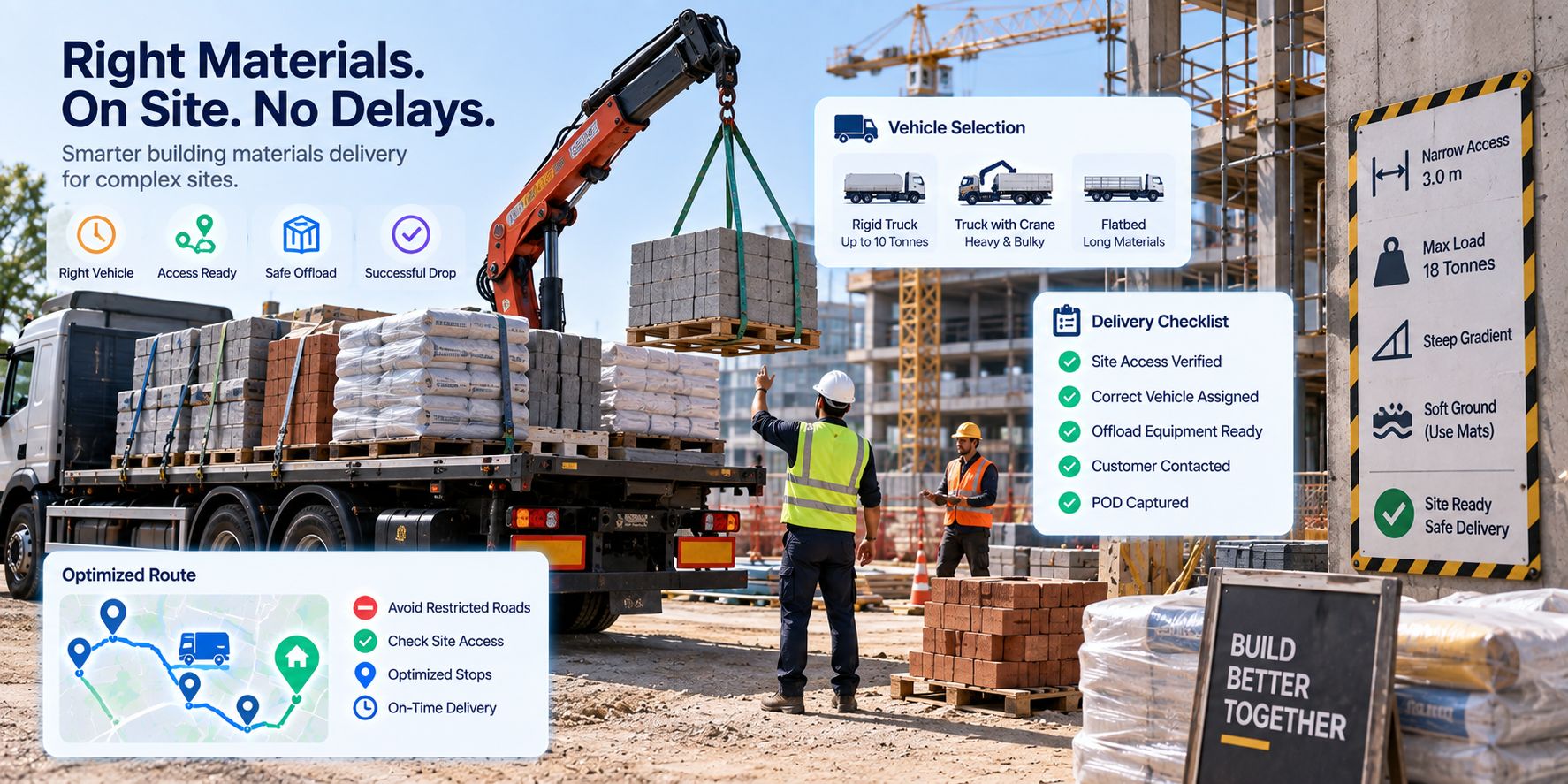
Building supplies are not parcels scaled up. A rigid truck can reach an address but still fail the stop because the access road is narrow, the ground is soft, overhead clearance is low, the crane setup area is occupied or nobody is authorized to direct the offload. The route plan therefore needs a site-feasibility layer before distance optimization begins.
A complete order record connects material dimensions and weight with vehicle capability, unloading method and site instructions. Dispatch should be able to answer three questions before release: can this vehicle legally and physically reach the site, can it unload safely using the planned equipment, and is the customer ready to receive it during the window?
What information should be captured before a building-material delivery?
Load
- Required detail
- Weight, dimensions, packaging and handling
- Planning decision
- Payload, deck space and securing needs
Access
- Required detail
- Width, height, gradient, surface and restrictions
- Planning decision
- Vehicle class and approach route
Offload
- Required detail
- Kerbside, forklift, crane or manual crew
- Planning decision
- Equipment and service time
Site
- Required detail
- Contact, hours, permit, exclusion zone and readiness
- Planning decision
- Window and release status
Placement
- Required detail
- Approved drop point and acceptance rule
- Planning decision
- Driver instructions and proof
| Area | Required detail | Planning decision |
|---|---|---|
| Load | Weight, dimensions, packaging and handling | Payload, deck space and securing needs |
| Access | Width, height, gradient, surface and restrictions | Vehicle class and approach route |
| Offload | Kerbside, forklift, crane or manual crew | Equipment and service time |
| Site | Contact, hours, permit, exclusion zone and readiness | Window and release status |
| Placement | Approved drop point and acceptance rule | Driver instructions and proof |
Turn site knowledge into reusable data
The first delivery to a construction site is expensive knowledge. Store verified access notes, map pin, approach direction, gate contact, photographs and actual unload duration against the location. The next planner should not have to rediscover a tight turn from a driver’s memory. Expire or reconfirm notes when the project phase changes because site conditions evolve quickly.
How should vehicles be matched to building-material orders?
Build an eligibility filter before route optimization. It checks payload, bed length, body type, crane or tail-lift availability, driver or crew skills and site limits. Only compatible combinations enter the optimizer. The shortest route assigned to a vehicle that cannot offload is not an optimized plan; it is a scheduled failure.
- Use multiple capacity dimensions where weight, volume and linear deck space can each become the binding constraint.
- Keep vehicle attachments and offload equipment as schedulable resources with availability status.
- Model two-person or banksman requirements as skills and crew counts, not free-text notes.
- Route commercial vehicles on approved road profiles and retain site-specific approach instructions.
- Include depot loading sequence so the first stop is accessible without moving half the truck.
Why failed drops cost more than redelivery
The visible cost is a second trip. The full cost includes the original truck and crew time, loading and reloading, equipment reservation, customer-site disruption, possible material damage, missed work on the next stops and the opportunity cost of a specialist vehicle. Track the failure reason and attributed cost by source: sales data, customer readiness, planning, depot or field execution.
Gate the route on readiness
Send the site contact a confirmation that states vehicle type, load, arrival band and unloading responsibility. Require acknowledgement for high-cost drops before the route is released, with an escalation path when confirmation is missing.
How to plan realistic offload time and sequence
Use service-time profiles by material and method, then improve them with actual history. Crane offloads need setup and pack-down time. Multi-floor handball work needs crew and access assumptions. A planner that applies ten minutes everywhere will make every later ETA wrong, even if the road sequence is perfect.
Sequence also affects loading. The depot should load in reverse stop order unless product shape or safety rules dictate otherwise. If a delivery contains items from multiple yard zones, capture pick readiness before publishing the route. Waiting at the yard is still route time from the customer’s perspective.
First-attempt success
- Purpose
- Shows planning and site readiness quality
- Best breakdown
- Failure reason, depot and salesperson
Actual vs planned dwell
- Purpose
- Improves service-time profiles
- Best breakdown
- Material, offload method and site
Vehicle utilization
- Purpose
- Balances payload and deck capacity
- Best breakdown
- Vehicle type and route
Specialist asset idle time
- Purpose
- Protects crane and forklift productivity
- Best breakdown
- Asset and day
Failed-drop cost
- Purpose
- Makes prevention investable
- Best breakdown
- Cause and customer segment
| Metric | Purpose | Best breakdown |
|---|---|---|
| First-attempt success | Shows planning and site readiness quality | Failure reason, depot and salesperson |
| Actual vs planned dwell | Improves service-time profiles | Material, offload method and site |
| Vehicle utilization | Balances payload and deck capacity | Vehicle type and route |
| Specialist asset idle time | Protects crane and forklift productivity | Asset and day |
| Failed-drop cost | Makes prevention investable | Cause and customer segment |
How to pilot building-supply delivery software
Choose a lane that includes both straightforward and difficult sites, then audit order and location data before asking the planner to improve routes. Define vehicle capability records, structured access fields, offload methods, customer confirmation and proof requirements. For two weeks, compare planned eligibility and dwell assumptions with driver feedback and actual stop events. Correct the data source instead of teaching one dispatcher a workaround that nobody else can see.
Introduce a formal release gate for the highest-cost deliveries. The route can be planned provisionally, but it should not publish until the load is ready, the selected equipment is available and the site has confirmed the agreed conditions. Track which gate blocks most often. That evidence tells commercial, yard and transport leaders where to fix the process before expanding automation to more depots.
How Geofleet supports complex site delivery
Geofleet brings order attributes, vehicle and driver eligibility, access notes, capacity-aware planning, checklists, customer communication and proof of delivery into one workflow. Building-supply teams can block unready sites, match specialist vehicles, plan realistic dwell time and retain photographs and acceptance against the stop. The command centre shows exceptions before they become an expensive return to the yard.
Related reading
Frequently asked questions
What is building materials delivery software?
It plans and controls heavy or bulky deliveries using load, vehicle, access, offload, customer-readiness and proof requirements.
Why does site access need to be checked before routing?
A road-valid route may still be impossible for the selected vehicle at the gate or offload point. Access determines vehicle eligibility and approach instructions.
How is offload time included in route planning?
Assign service-time profiles by material and unloading method, then recalibrate them with actual stop history rather than using one generic duration.
What proof should be captured for a heavy delivery?
Capture arrival, load condition, approved placement, photographs, exceptions and recipient acceptance, tied to the route and order record.