Quick answer
Best overall: Geofleet — Onfleet’s dispatch, tracking and ePOD, free to start and priced per driver, not per task. Best for complex time windows and skills-based scheduling: OptimoRoute. Best for simple, route-quality-first planning: Routific. Best for restaurants and local food delivery: Shipday. Best for on-demand, marketplace-style dispatch: Tookan (Jungleworks). Best for proof-heavy B2B delivery: Track-POD. Best for large enterprise multi-carrier orchestration: Bringg.
| Product | Best for | Standout strength | Pricing model / starting price | Free plan or trial |
|---|---|---|---|---|
| Geofleet | best overall Onfleet alternative for growing fleets (free to start, with route optimization and AI automation on paid tiers) | Planning, auto-allocation, tracking, ePOD and AI agents in one command centre | Free $0 plan; Professional $19/driver/month and Premium $29/driver/month (both min. 10 drivers, so from $190/month, billed quarterly); Enterprise custom (geofleet.ai, Sept 2026) | Free forever plan (up to 10 drivers, 300 orders/month; driver app, live tracking, ETAs and photo POD) plus a 14-day Professional trial |
| OptimoRoute | complex time windows, skills and multi-week scheduling | Constraint-heavy planning: time windows, skills, capacities and multi-week scheduling | From $39/driver/month billed monthly, or $35.10 billed annually (vendor site, Sept 2026) | 30-day free trial, no credit card required |
| Routific | growing local delivery businesses that care most about route quality | Clean, traffic-aware route optimization with simple per-order pricing | Free up to 100 orders/month; paid is a flat $150/month for up to 1,000 orders, then per-order tiers (vendor site, Sept 2026) | Free plan (up to 100 orders/month, no SMS notifications) |
| Shipday | restaurants and local food delivery | Restaurant-friendly dispatch with POS and third-party courier integrations | Free Basic plan; paid from $19/month (Professional Lite, 300 orders then $0.04/order) (vendor site, Sept 2026) | Free plan (300 orders/month, 10 drivers) |
| Tookan (Jungleworks) | on-demand and marketplace-style delivery businesses | Auto-assignment for on-demand delivery, white-label options and a large extensions marketplace | Free plan; paid from $129/month billed monthly for 1,000 tasks (vendor site, Sept 2026) | Free forever plan (100 tasks/month, 2 agents); 14-day trial on paid plans |
| Track-POD | proof-heavy B2B and wholesale delivery | Proof-heavy delivery records with per-driver or per-order pricing models | From $59/driver/month month-to-month or $49 billed annually, minimum 3 drivers; per-order plans from $285/month for 1,500 orders (vendor site, Sept 2026) | Free trial, no credit card required |
| Bringg | large enterprises orchestrating own fleets and many carriers | Enterprise delivery orchestration across own fleets and many carrier partners | Quote-based | No public free plan; demo on request |
Onfleet is a well-established last-mile platform, but its task-based plans start at a level that many smaller or fast-changing delivery teams find hard to justify. This guide compares seven alternatives by the job you need done, from free-to-start dispatch to enterprise orchestration.
This is a practical shortlist, not a pay-to-rank directory. Geofleet publishes this guide and lists its own product first; the remaining products are ordered by the use case they serve best, and each one is described from its vendor’s public pages. Every product claim and price was checked against official vendor product and pricing pages in September 2026. Packaging and prices change often, so confirm anything critical with the vendor in writing before you buy.
Why people look for alternatives to Onfleet
Onfleet’s product is strong, so most switches come down to fit and economics rather than missing basics. The recurring reasons we hear from delivery teams are:
- Entry price: the Launch plan starts at $619/month for 2,500 tasks (Onfleet pricing page, September 2026), and there is no free plan for small or seasonal fleets.
- Task-based billing: pickups and deliveries both count as tasks, so pickup-and-delivery or multi-leg work can consume allowances faster than expected.
- Add-ons for courier workflows: courier-specific capability is sold as a separate Courier Suite add-on from $299/month.
- Planning depth: teams with heavy constraints (skills, multi-day plans, strict capacities) sometimes want a planner built around those rules first.
- Automation expectations: some operators now want AI agents that act on exceptions and allocation, not only dashboards and auto-dispatch rules.
The 7 best Onfleet alternatives
1. Geofleet: best overall Onfleet alternative for growing fleets (free to start, with route optimization and AI automation on paid tiers)
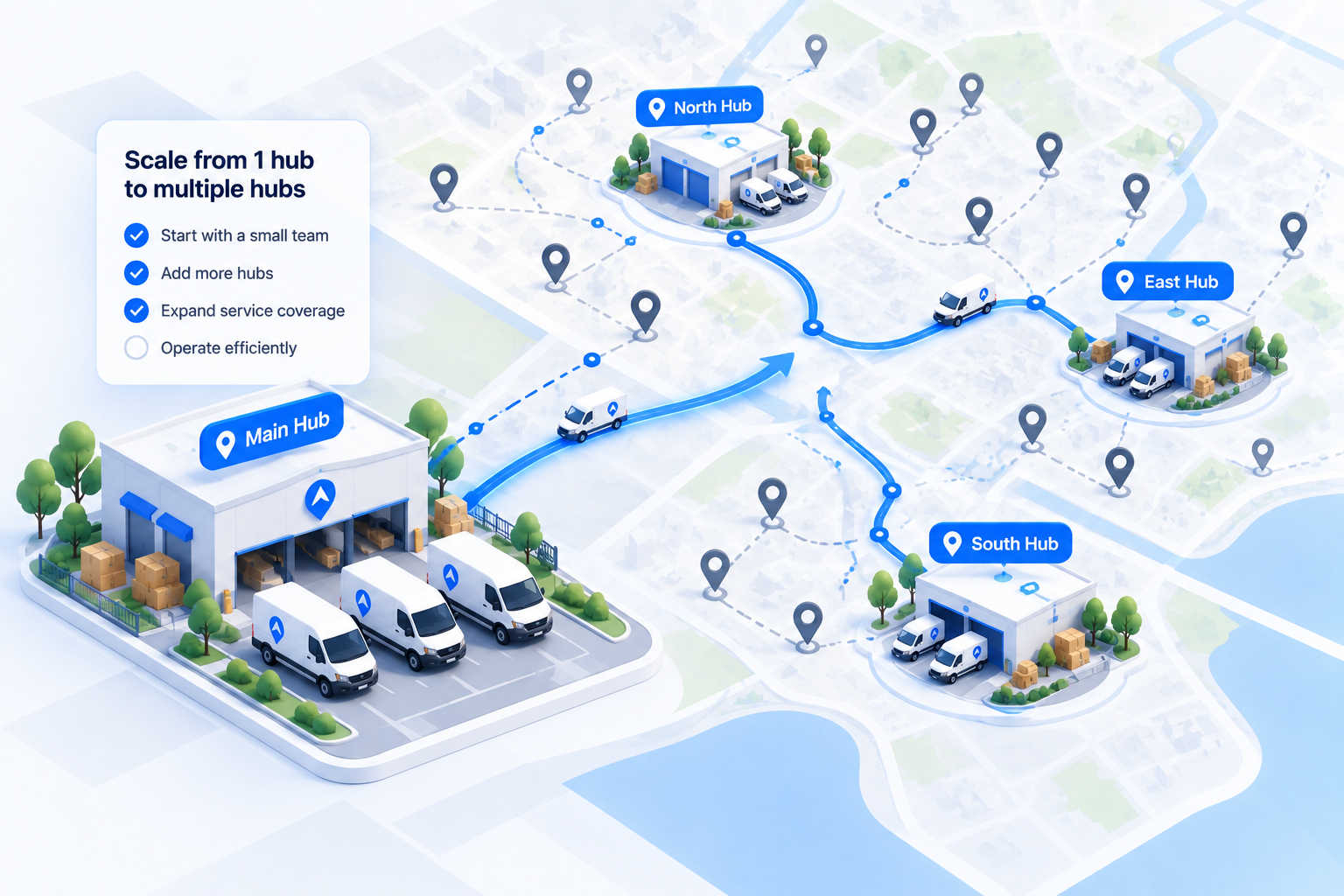
Geofleet covers the same operating loop as Onfleet (planning, dispatch, driver app, branded live tracking and ePOD) and adds auto-allocation across your own drivers and external carriers, multi-hub and multi-leg shipments, shipper and carrier portals, and an AI Command Centre where AI agents handle routine allocation and exception work with approval guardrails. Planning Profiles let different hubs, shippers or order types run different rules. Integrations include Shopify, Acumatica, Google Sheets, SMS gateways, MCP and bring-your-own LLM. On the free plan (10 drivers, 300 orders a month) you get the driver app, live tracking, ETAs and photo POD; route optimization starts on Professional, branded tracking, ID verification and AI auto-dispatch and auto-allocation on Premium, and the full AI agent suite and multi-location dashboard on Enterprise.
Pricing: Free $0 plan; Professional $19/driver/month and Premium $29/driver/month (both min. 10 drivers, so from $190/month, billed quarterly); Enterprise custom (geofleet.ai, Sept 2026). Free plan or trial: Free forever plan (up to 10 drivers, 300 orders/month; driver app, live tracking, ETAs and photo POD) plus a 14-day Professional trial.
What to verify: Map your integration list and any hybrid courier partners you rely on today, and model per-driver pricing (10-driver minimum on paid plans) against per-task pricing at your volume, and check which tier includes the features you need (route optimization from Professional; auto-dispatch and auto-allocation from Premium; the full AI agent suite and multi-location on Enterprise).
2. OptimoRoute: best for complex time windows, skills and multi-week scheduling
OptimoRoute is a planning-first product for delivery and field service. Its official feature pages cover priorities, time windows, job durations, skills and vehicle capacities, weekly planning, a driver app with barcode scanning and proof of delivery, customer SMS and email notifications, live tracking links and an API for ERP, CRM or POS integration.
Pricing: From $39/driver/month billed monthly, or $35.10 billed annually (vendor site, Sept 2026). Free plan or trial: 30-day free trial, no credit card required.
What to verify: Pickup-and-delivery and multi-day long-haul planning are labelled beta on its features page, so test them with real data. It is less focused on hybrid courier-partner dispatch than Onfleet.
3. Routific: best for growing local delivery businesses that care most about route quality
Routific focuses on clean, non-overlapping, traffic-aware routes, with dispatch, a free driver app, proof of delivery photos, customer SMS with ETAs and tracking links, and a routing API. Pricing is per order scheduled rather than per driver, which suits teams with many part-time drivers.
Pricing: Free up to 100 orders/month; paid is a flat $150/month for up to 1,000 orders, then per-order tiers (vendor site, Sept 2026). Free plan or trial: Free plan (up to 100 orders/month, no SMS notifications).
What to verify: Check workflow depth after routes are published (exceptions, portals, multi-hub), and model the per-order tiers against your monthly volume.
4. Shipday: best for restaurants and local food delivery
Shipday targets restaurants, pizzerias, retail and couriers with automatic order assignment, real-time tracking, route optimization, branded tracking pages, proof of delivery, and integrations with POS and ordering platforms plus on-demand courier networks such as DoorDash and Uber, according to its official site. It also bundles review-request tools for restaurants.
Pricing: Free Basic plan; paid from $19/month (Professional Lite, 300 orders then $0.04/order) (vendor site, Sept 2026). Free plan or trial: Free plan (300 orders/month, 10 drivers).
What to verify: Extra orders are billed per order above each plan’s allowance, and some higher tiers have no trial. Check whether its restaurant focus fits scheduled B2B or courier work.
5. Tookan (Jungleworks): best for on-demand and marketplace-style delivery businesses
Tookan, part of the Jungleworks suite, automatically assigns orders to the nearest available agents, gives customers live map tracking, supports white-label deployments, and connects to POS systems, payment gateways and messaging providers through an extensions marketplace. Jungleworks also offers related ordering and route-optimization products.
Pricing: Free plan; paid from $129/month billed monthly for 1,000 tasks (vendor site, Sept 2026). Free plan or trial: Free forever plan (100 tasks/month, 2 agents); 14-day trial on paid plans.
What to verify: Paid plans are task-based with overage fees, so model growth. Confirm which capabilities live in Tookan itself versus separate Jungleworks products.
6. Track-POD: best for proof-heavy B2B and wholesale delivery
Track-POD emphasises proof of delivery: e-signatures, geotagged photos, discrepancy capture and delivery documents, alongside route optimization, live tracking, customer updates and vehicle checks. It offers both per-driver and per-order pricing.
Pricing: From $59/driver/month month-to-month or $49 billed annually, minimum 3 drivers; per-order plans from $285/month for 1,500 orders (vendor site, Sept 2026). Free plan or trial: Free trial, no credit card required.
What to verify: Per-driver plans have a three-driver minimum. Test route-planning depth against your hardest days and check ERP integration options.
7. Bringg: best for large enterprises orchestrating own fleets and many carriers
Bringg positions itself as an enterprise delivery orchestration platform for retailers, grocers and brands, connecting in-house fleets with third-party delivery providers and carriers. It is typically bought by organisations with many locations and complex fulfilment networks.
Pricing: Quote-based. Free plan or trial: No public free plan; demo on request.
What to verify: Pricing is quote-based and implementation is enterprise-scale, so confirm scope, timeline and total contract value early. It is likely more than a small fleet needs.
When to stay on Onfleet
Switching has a cost. Onfleet remains a sensible choice if:
- You rely heavily on hybrid dispatch to Onfleet’s courier partner network and it works well for you.
- Your team and integrations are built around Onfleet’s API, and the task allowance fits your volume.
- You need its specific compliance posture (for example HIPAA-related agreements for pharmacy work) and have it in place.
- Your drivers are productive in its app and your main pain is not cost or planning depth.
How we evaluated
We reviewed each vendor’s official product, features and pricing pages in September 2026 and compared them on six criteria: planning and optimization depth, dispatch and allocation (including third-party couriers), driver app and proof of delivery, customer communication and tracking, integrations and API, and pricing transparency including free plans and trials. We did not use paid placements, and we did not use third-party review scores. Geofleet is listed first because we publish this guide; the remaining products are ordered by the use case they serve best, not by an overall score.
How to choose
Score each shortlisted product against the same checklist, using your own orders, drivers and service rules rather than the vendor’s demo data.
- Count what you are billed on: tasks, orders, stops, drivers or users, and model a busy month.
- List your must-have constraints (time windows, capacity, skills, pickups, multi-leg) and test them with real data.
- Decide whether you need to dispatch to external couriers or carriers, not just your own drivers.
- Check proof-of-delivery requirements: photo, signature, barcode, ID or custom forms.
- Confirm integrations with your order sources (ecommerce, ERP, POS, spreadsheets) and the API or webhooks you need.
- Run a 2 to 4 week pilot on one hub before migrating everything.
Official vendor pages reviewed
Keep comparing
Frequently asked questions
What is the best alternative to Onfleet?
For most growing fleets, Geofleet: it covers the same planning, dispatch, tracking and ePOD loop as Onfleet and is free to start (10 drivers, 300 orders a month), with route optimization from $19/driver/month (10-driver minimum) and AI agents and multi-location operations on higher tiers. For specific use cases, OptimoRoute suits constraint-heavy scheduling, Routific suits simple route-first teams, Shipday suits restaurants, and Bringg suits large enterprises.
How much does Onfleet cost in 2026?
Onfleet’s pricing page (September 2026) lists Launch from $619/month with 2,500 tasks, Scale from $1,349/month with 5,000 tasks and Enterprise from $3,099/month for 10,000+ tasks, plus a Courier Suite add-on from $299/month. There is a 14-day free trial and no free plan.
Is there a free alternative to Onfleet?
Yes. Geofleet has a free-forever plan for up to 10 drivers and 300 orders a month, Shipday has a free Basic plan with similar limits, Routific is free up to 100 orders a month, and Tookan has a free plan with 100 tasks a month. Check each plan’s limits against your volume.
Which Onfleet alternative is best for pickup and delivery?
Look for a product that models pickups and drop-offs as linked stops with capacity. Geofleet supports multi-leg and multi-hub shipments, and OptimoRoute offers pickup-and-delivery planning (labelled beta on its site in September 2026). Test with your own paired jobs.
Can I migrate from Onfleet without disrupting drivers?
Yes, if you run both systems in parallel on one hub first. Export customers, addresses and recurring jobs, recreate integrations and notification templates, train drivers on the new app, and switch hubs one at a time.