Quick answer
Best overall: Geofleet — constraint-aware planning tied to live dispatch, allocation and planned-versus-actual feedback. Best for clean routes with simple pricing: Routific. Best for time windows and field-service schedules: OptimoRoute. Best for multi-depot routing configuration: Route4Me. Best for small teams planning daily: Upper. Best for deep constraint and cost configuration: eLogii. Best for optimization inside a wider last-mile product: Onfleet.
How we judged the solvers
In September 2026 we reviewed each vendor’s official product, pricing and documentation pages with one question in mind: will this optimizer produce routes a real fleet can drive, and keep them valid when the day changes? We looked at constraint coverage, objectives, multi-depot support, manual control, re-optimization and API access. Geofleet publishes this guide and puts itself first; the remaining six are ranked by how well they suit a delivery fleet with several vehicles and time windows.
Which constraints matter for your fleet?
Before any demo, write down every rule a dispatcher enforces from memory. Mark each as hard (must never break) or soft (break with a penalty). This list becomes your test script.
Time windows
- Why it matters
- Missed windows drive failed deliveries
- Test question for the vendor
- Can a stop have two windows, and is a breach hard or penalised?
Capacity
- Why it matters
- Overloaded vans cause second trips
- Test question for the vendor
- Can weight, volume and item count apply at once?
Shifts and breaks
- Why it matters
- Legal limits and driver goodwill
- Test question for the vendor
- Are breaks placed automatically inside the route?
Skills and vehicle type
- Why it matters
- Refrigeration, lift gates, ID checks
- Test question for the vendor
- Can an order require a skill and a vehicle type together?
Pickup before delivery
- Why it matters
- Courier and returns work
- Test question for the vendor
- Are linked pairs kept on the same vehicle in order?
Multiple depots
- Why it matters
- Regional fleets and reloads
- Test question for the vendor
- Can a vehicle end at a different depot or reload mid-route?
Service time
- Why it matters
- Stairs, parking, paperwork
- Test question for the vendor
- Can service time vary by customer or item count?
| Constraint | Why it matters | Test question for the vendor |
|---|---|---|
| Time windows | Missed windows drive failed deliveries | Can a stop have two windows, and is a breach hard or penalised? |
| Capacity | Overloaded vans cause second trips | Can weight, volume and item count apply at once? |
| Shifts and breaks | Legal limits and driver goodwill | Are breaks placed automatically inside the route? |
| Skills and vehicle type | Refrigeration, lift gates, ID checks | Can an order require a skill and a vehicle type together? |
| Pickup before delivery | Courier and returns work | Are linked pairs kept on the same vehicle in order? |
| Multiple depots | Regional fleets and reloads | Can a vehicle end at a different depot or reload mid-route? |
| Service time | Stairs, parking, paperwork | Can service time vary by customer or item count? |
Solver quality: what separates a good plan from a short one
Two tools can respect the same constraints and still produce very different days. Compare them on these qualities rather than a single mileage number.
- Objective: does the solver minimise distance, time, vehicles used or cost, and can you choose?
- Balance: are workloads even across drivers, or does one route finish at 2 p.m. and another at 7 p.m.?
- Driveability: do routes avoid criss-crossing, U-turns and zig-zags that drivers will override?
- Explainability: when an order stays unassigned, does the tool say which rule blocked it?
- Speed: how long does a full re-plan take at your peak order count?
Seven route optimization tools compared
1. Geofleet: optimization that stays connected to live dispatch
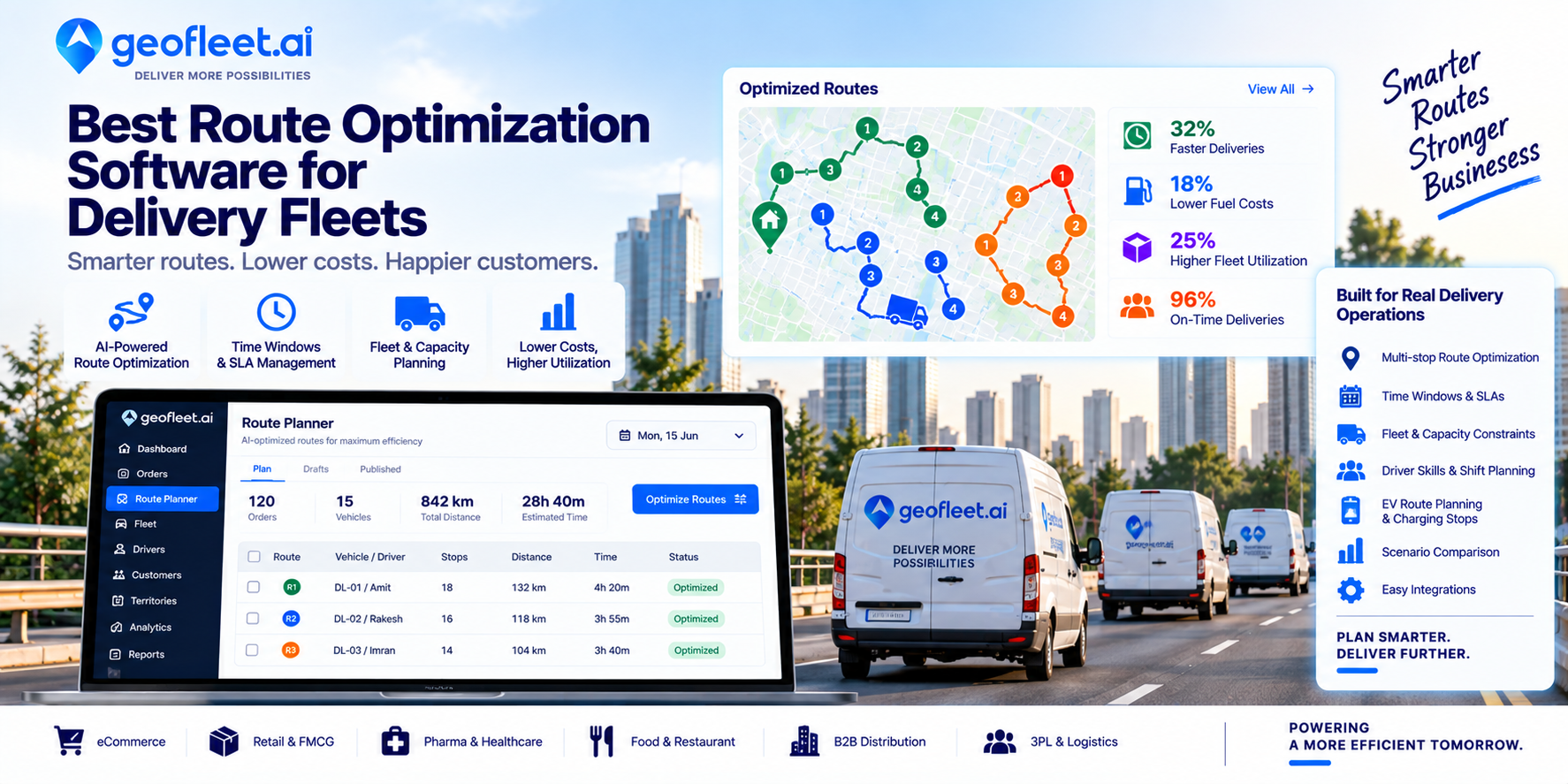
Geofleet’s planner handles time windows, capacities, shifts, skills, pickups and multiple hubs, and Planning Profiles let each hub, weekday, shipper or order type run its own constraint set and objective. The difference shows after publishing: AI auto-dispatch and auto-allocation (Premium) re-slot urgent orders against the live plan, drivers receive changes in the app, and planned-versus-actual data flows back into the next plan. Route optimization is included from the Professional tier.
Benchmark this: Load your hardest historical day, lock a few stops manually, then insert urgent orders and inspect every changed ETA before publishing.
2. Routific: clean, driveable routes with simple pricing
Routific’s reputation rests on routes that look sensible to drivers: compact, non-overlapping and traffic-aware. Planners can set time windows, vehicle capacities, driver speeds and route balance, and the same engine is available as an optimization API. Pricing is by order volume, with a free tier up to 100 orders a month and a flat $150 a month for 101–1,000 orders (vendor site, Sept 2026).
Benchmark this: Test pickup-and-delivery pairs and mid-day re-optimization, which matter more as volumes grow.
3. OptimoRoute: time windows, multi-day plans and field-service schedules
OptimoRoute is a planning-first tool used for both deliveries and service visits. Its pages highlight multi-driver planning with time and capacity constraints, workload balancing and scheduling across days. Paid plans are per driver, from $35.10 per driver per month billed annually on Lite, with a 30-day free trial (vendor site, Sept 2026).
Benchmark this: Run linked pickups and deliveries and a multi-day horizon on the plan tier you would actually buy.
4. Route4Me: multi-depot routing with many configuration switches
Route4Me offers dynamic and recurring optimization, multiple depots and vehicle types, and commercial-vehicle constraints within a modular platform. That flexibility suits teams with unusual routing rules who are comfortable assembling and administering several components.
Benchmark this: Confirm which constraints need extra modules and how much administration a planner faces each morning.
5. Upper: small teams that plan routes every morning
Upper aims at small and midsize teams that need multi-stop routes planned quickly, with dispatch, a driver app and live GPS alongside. Its pages describe dispatcher-reviewed AI assistance. Plans are per user, from $40 per user per month billed yearly on Starter, with a 7-day trial (vendor site, Sept 2026).
Benchmark this: Check which plan includes the constraints you need, such as time windows and capacity, and how live changes reach drivers.
6. eLogii: deep constraint and cost-objective configuration
eLogii exposes an unusually wide constraint set: multiple depots, multi-day work, skills, vehicle and hazardous-material restrictions, cost-based objectives, recurring tasks and live re-optimization. That depth helps complex fleets and asks for a proper configuration phase.
Benchmark this: Hold a configuration workshop with your real rules and measure how long a planner needs to adjust them.
7. Onfleet: optimization inside a broader last-mile product
Onfleet includes route optimization as part of its last-mile platform. Its pricing page lists basic route optimization on Launch and advanced optimization with API access on Scale (vendor site, Sept 2026), so the depth of the solver depends on the plan.
Benchmark this: Compare Launch and Scale on the same order file to see what the advanced optimizer changes.
Re-optimization: what happens after routes go out
Static plans start decaying the moment drivers leave. Urgent orders, cancellations, a sick driver or a closed road all force a decision: re-plan everything, patch one route, or ignore it. Good software lets a dispatcher lock stops already promised, insert new work, preview every affected ETA and push the change to drivers and customers in one step. Ask each vendor to show this live rather than describe it, and note whether changed ETAs trigger customer messages automatically.
How to benchmark routes: a fair 30-day proof of concept
Pick one hub, a stable group of drivers and real order imports, including at least one of your hardest days. Keep the current process running as a control. Do not let planners hand-fix every route before drivers see it; the point is to measure how each tool behaves with normal data and normal staff.
Planning
- Measure
- Planner minutes, unassigned orders and manual edits
- Evidence
- System audit plus dispatcher log
Route quality
- Measure
- Distance, drive time and stops per hour versus control
- Evidence
- Plan exports and GPS traces
Execution
- Measure
- On-time rate and planned-versus-actual sequence
- Evidence
- Trip and stop events
Re-optimization
- Measure
- Time to insert an urgent order and ETAs changed
- Evidence
- Dispatcher timings
Driver feedback
- Measure
- Routes drivers resequenced or rejected
- Evidence
- App events and debrief notes
Commercials
- Measure
- Cost per completed stop at your volume
- Evidence
- Quoted plan and internal time
| Area | Measure | Evidence |
|---|---|---|
| Planning | Planner minutes, unassigned orders and manual edits | System audit plus dispatcher log |
| Route quality | Distance, drive time and stops per hour versus control | Plan exports and GPS traces |
| Execution | On-time rate and planned-versus-actual sequence | Trip and stop events |
| Re-optimization | Time to insert an urgent order and ETAs changed | Dispatcher timings |
| Driver feedback | Routes drivers resequenced or rejected | App events and debrief notes |
| Commercials | Cost per completed stop at your volume | Quoted plan and internal time |
Agree definitions before day one. One vendor may count on-time against the planned ETA and another against the customer window; one may count an attempted stop as complete. Normalise those rules or the pilot will reward reporting differences rather than better routes.
Where Geofleet fits
Geofleet fits fleets whose routing rules differ by hub, customer or day, and who need the optimized plan to survive live change. Route optimization starts on the Professional plan ($19 per driver per month, 10-driver minimum, billed quarterly) together with SMS or WhatsApp messages and API and webhook access. Premium ($29 per driver per month) adds AI auto-dispatch and auto-allocation for re-slotting work in real time. Teams can trial the driver app and live tracking on the Free plan first.
Go deeper on routing
Frequently asked questions
What is the best route optimization software for delivery fleets?
Geofleet ranks first here for fleets that need optimization tied to live dispatch. Routific suits clean routes with simple pricing, OptimoRoute scheduled windows, Route4Me multi-depot configuration, Upper small daily planners, eLogii deep constraints and Onfleet optimization within last-mile.
What is the difference between hard and soft constraints?
A hard constraint must never be broken, such as vehicle capacity. A soft constraint can be broken at a cost, such as a preferred delivery window, and the solver weighs that cost against other goals.
How long should a route optimization pilot run?
Around 30 days usually captures normal weeks plus at least one peak or difficult day. Shorter pilots tend to miss the edge cases that decide whether planners trust the tool.
Why do drivers change optimized routes?
Usually because the plan misses something they know: parking, loading order, access times or realistic service time. Track these edits during a pilot and feed the rules back into the planner.
Is Google Maps enough for route optimization?
Google Maps is strong navigation but does not assign stops across many vehicles with capacities, windows, shifts and skills, and it does not manage dispatch or proof.
How often should routes be re-optimized?
Whenever a change affects promised ETAs, such as urgent inserts, cancellations or a driver dropping out. Lock stops already promised and re-plan the rest.