The rise of quick commerce has fundamentally changed customer expectations. What was once considered a premium service—delivery within an hour—is now being replaced by promises of 10–20 minute fulfillment. Customers no longer just value convenience; they expect speed as a standard part of the experience. For businesses, this shift creates both an opportunity and a challenge.
Enabling ultra-fast delivery is not simply about moving faster—it requires rethinking the entire operational model. From how delivery zones are defined to how orders are prepared and assigned, every step must be optimized for speed. Even small inefficiencies, such as a delay in order preparation or a suboptimal driver assignment, can make the difference between meeting or missing a 20-minute promise.
- Speed alone is not enough—consistency is what builds trust.
- Operations must be tightly optimized across all stages.
- Every minute in the delivery lifecycle impacts overall performance.
- Coordination between systems and teams is critical.
The key to achieving this level of performance is designing operations specifically for speed, rather than adapting slower systems to work faster.
What Makes 10–20 Minute Delivery Possible
Ultra-fast delivery is only possible when multiple factors align perfectly. It is not driven by a single improvement but by the combined effect of optimized distance, efficient routing, and real-time decision-making.
The most successful quick-delivery models are built around hyperlocal operations, where distances are minimized and execution is highly controlled.
- Short delivery distances, typically within a 2–4 km radius.
- Predictable traffic conditions and optimized routes.
- Instant driver assignment without manual intervention.
- Real-time routing that adapts to current conditions.
- Minimal delay between order readiness and dispatch.
Distance dominates the clock
The typical radius behind a reliable 10-20 minute promise. Short distances are the single biggest factor in hitting the window consistently, far more than raw driver speed.
When these elements are aligned, businesses can consistently achieve delivery times within the 10–20 minute window.
Where the Minutes Go
Hitting a sub-20-minute promise means accounting for every stage of the lifecycle, not just the drive. The breakdown below shows where time is spent and where the biggest savings usually hide.
Order to ready
- Where time goes
- Preparation, picking
- How to compress it
- Pre-stage popular items
Assignment
- Where time goes
- Finding a driver
- How to compress it
- Instant auto-dispatch
Travel
- Where time goes
- Distance and traffic
- How to compress it
- Tight hyperlocal zones
Handoff
- Where time goes
- Finding the customer
- How to compress it
- Live tracking and ETAs
| Stage | Where time goes | How to compress it |
|---|---|---|
| Order to ready | Preparation, picking | Pre-stage popular items |
| Assignment | Finding a driver | Instant auto-dispatch |
| Travel | Distance and traffic | Tight hyperlocal zones |
| Handoff | Finding the customer | Live tracking and ETAs |
Key Operational Requirements
Achieving fast delivery requires a disciplined approach to operations. Businesses must design systems and processes that eliminate delays and ensure seamless coordination between preparation, dispatch, and delivery.
- Define tight delivery zones with clear time commitments.
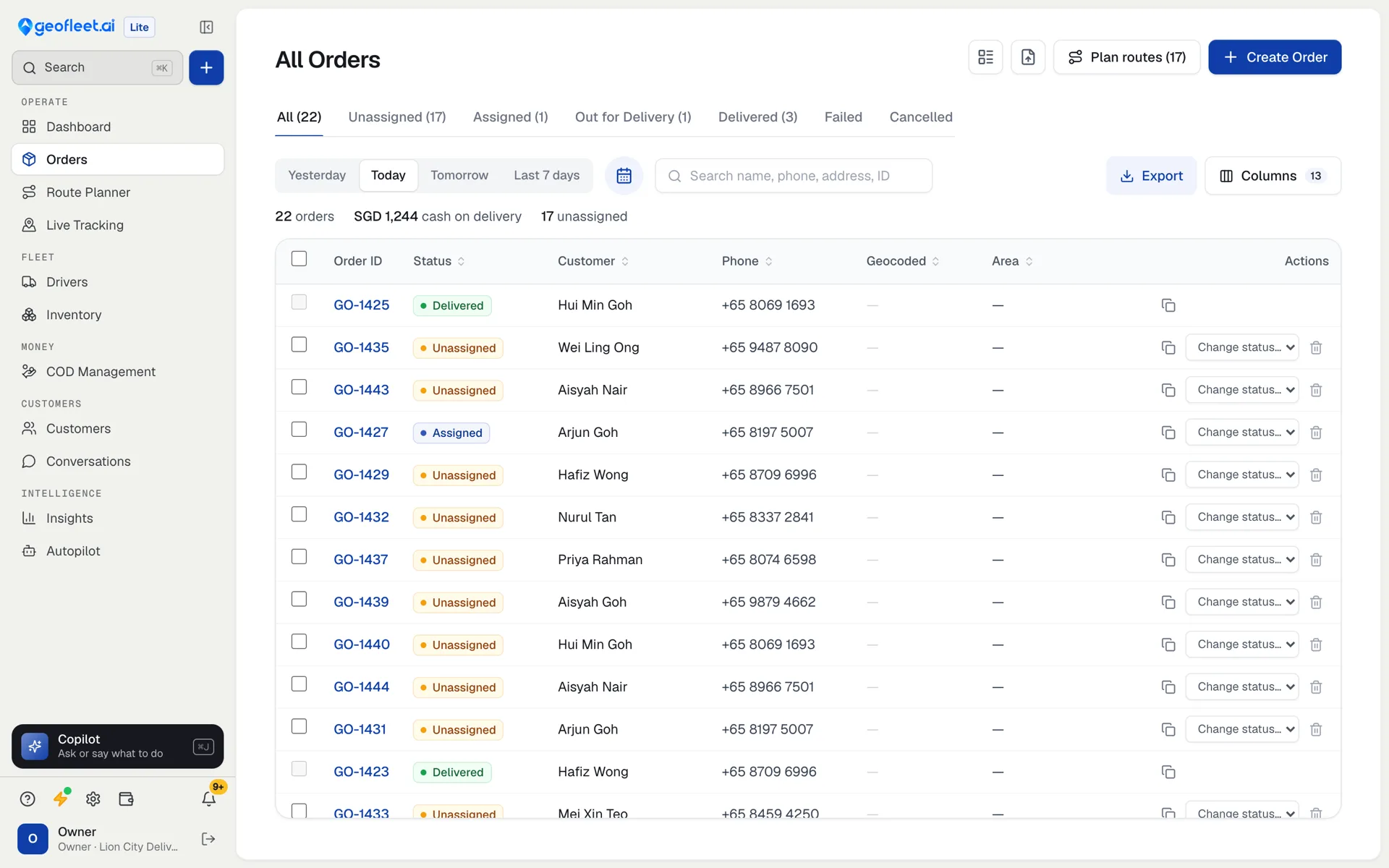
- Ensure accurate inventory visibility to avoid delays in order preparation.
- Assign drivers instantly as soon as orders are ready.
- Maintain sufficient driver availability within each zone.
- Align kitchen/store preparation time with dispatch readiness.
These requirements form the operational backbone of any successful quick-delivery system.
How Geofleet Enables Fast Delivery Operations
Geofleet provides the infrastructure needed to execute ultra-fast delivery at scale. By automating key processes and enabling real-time decision-making, it removes the bottlenecks that typically slow down operations.
- Create and manage hyperlocal delivery zones with defined time promises.
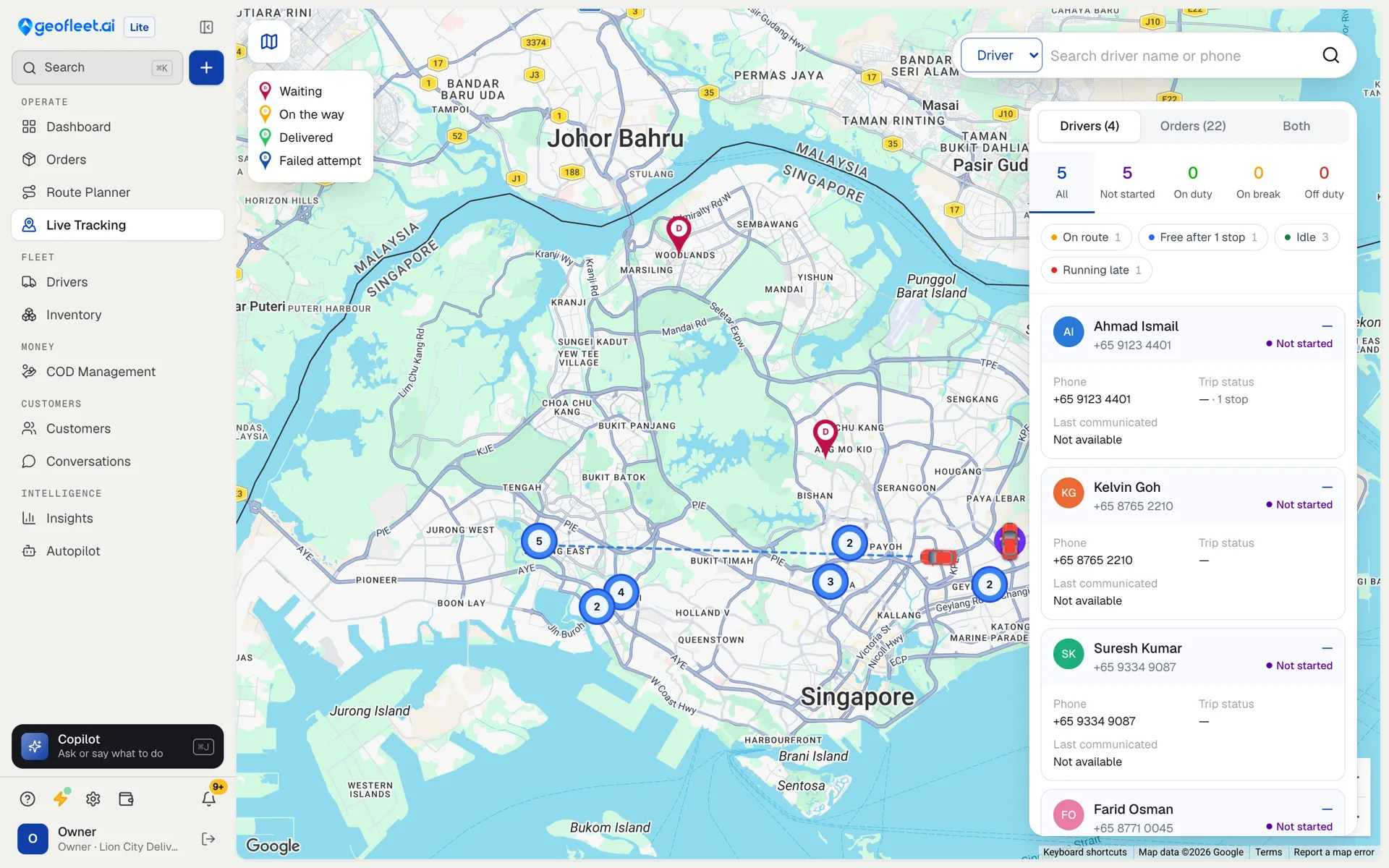
- Automatically assign the nearest available driver to each order.
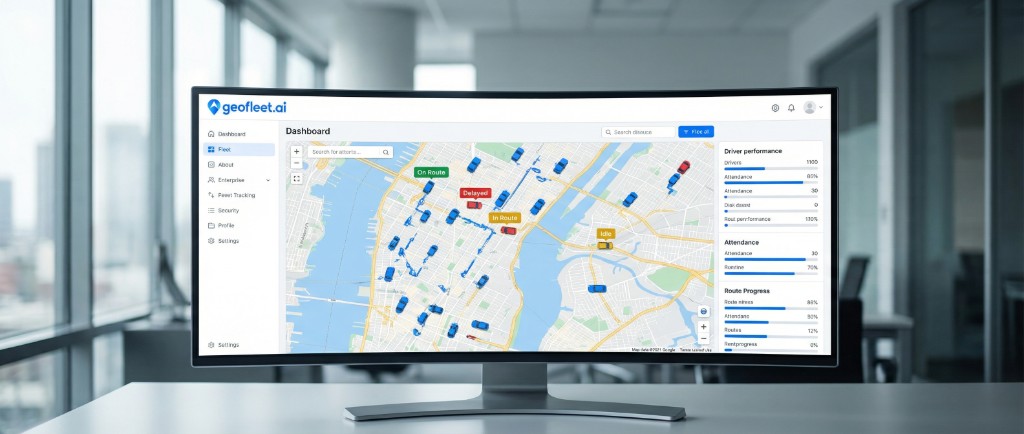
- Generate optimized routes instantly based on real-time conditions.
- Provide live tracking and predictive ETAs for customers.
- Enable batching of nearby orders to improve efficiency without increasing delivery time.
This combination of automation and real-time visibility ensures that operations remain fast, efficient, and scalable.
Common Mistakes That Break Fast Delivery
Many businesses attempt to offer fast delivery without aligning their operations, leading to inconsistent performance and missed promises. Avoiding these common mistakes is critical for success.
- Promising ultra-fast delivery without defining proper delivery zones.
- Insufficient driver availability during peak demand periods.
- Delays in order preparation before dispatch begins.
- Lack of coordination between preparation and delivery teams.
- Overloading drivers with multiple orders beyond capacity.
Addressing these issues ensures that speed promises are realistic and consistently achievable.
"We enabled 15-minute delivery using tightly defined zones and instant dispatch. Our on-time performance improved significantly within weeks."
— Head of Quick Commerce, QSR Brand
How to Get Started with 10–20 Minute Delivery
Implementing fast delivery does not require a full-scale rollout from day one. A phased approach allows businesses to test, refine, and scale their operations effectively.
- Start with a single store or a limited delivery zone.
- Focus on high-demand products that can be prepared quickly.
- Define realistic delivery time windows based on actual conditions.
- Track performance metrics such as on-time rate and delivery duration.
- Continuously optimize zones, staffing, and processes.
This approach reduces risk and ensures that the model is sustainable before scaling to additional locations.
Final Thoughts: Speed as a Competitive Advantage
10–20 minute delivery is no longer just a differentiator—it is quickly becoming a baseline expectation in many markets. Businesses that can deliver consistently within this window gain a significant competitive advantage in customer acquisition and retention.
The key is not just speed, but reliability. By combining tight operational control, real-time systems, and continuous optimization, businesses can build a fast delivery model that is both efficient and scalable.
Frequently asked questions
What makes 10–20 minute delivery possible?
Ultra-fast delivery depends on short delivery distances (typically a 2–4 km radius), instant driver assignment, real-time routing, and minimal delay between order readiness and dispatch.
How large should a quick-commerce delivery zone be?
Hyperlocal zones of roughly 2–4 km work best. Short distances are the biggest factor in consistently meeting a 10–20 minute promise.
What are the most common mistakes in fast delivery?
Promising speed without defined zones, insufficient driver availability at peak times, delays in order preparation, poor coordination between teams, and overloading drivers beyond capacity.
How should I launch fast delivery?
Start with a single store or limited zone, focus on quick-to-prepare high-demand products, set realistic time windows, track on-time performance, and optimize before scaling.
Does batching orders break the 10-20 minute promise?
Not if done carefully. Batching only nearby orders that are ready at the same time can improve efficiency without adding meaningful delay. Over-batching to chase utilization is what breaks the promise.
What is the biggest lever for hitting fast delivery times?
Distance. A tight 2-4 km zone does more for consistency than any other single factor, because it caps travel time regardless of traffic or driver availability swings.